I have been into the paranormal since I was a kid. I have enjoyed all kinds of topics such as the Loch Ness Monster and UFOs. However one of my favorites of all time has got to be the big guy “bigfoot”. Bigfoot is always been one of those hot topics which people completely do not believe in or are completely devoted to finding it. Not only is the topic hot blooded but so are the different character types within the Sasquatch community. The community has it all, from true believers to the individual's who are in it to make a fast buck. There are even a number of infamous individuals who are complete hoaxers and proud of it. The topic of Bigfoot is hot at the moment and everyone seems to have his or her thoughts on the subject. This blog is my take on recent Bigfoot sightings reports and alleged evidence found. Whether Bigfoot/Sasquatch is real or not really doesn’t make a difference, it’s still quite a story to ponder. From the indigenous Indians to modern times Bigfoot is the shining star of the Cryptozoology world. Is bigfoot real, you decide!

Tuesday, June 8, 2021

Sasquatch Encounter

Sasquatch is a bigfoot-like creature described in folklore. The mythical beast is said to resemble a large, hairy human with an opposable thumb on its feet and is most often reported in the Pacific Northwest states of the United States and Canada. Although sightings of sasquatch are still recorded today, there is no proof that the creature exists outside of legend or hoax. Sasquatch encounters are strange phenomena that continue to pose a conundrum for cryptozoologists and researchers alike. While there are many eyewitness accounts of sasquatch sightings in the Pacific North West, scientific evidence that these creatures actually exist has yet to be presented, leading most to dismiss them as a myth. 

However, some people subscribe to the idea that the sasquatch is a relict species of some kind. Resembling a human with an opposable thumb on its feet and weighing up to 1,000 pounds, sasquatch is usually depicted as a thickly built dark-brown hominid keeping to itself and living in remote wooded areas. Usually nocturnal, it is most active at dusk or dawn when one might potentially encounter the beast. The sasquatch is not seen too much by humans, either. The mythical animal rarely interacts with people except when defending its own territory or eating presumably.
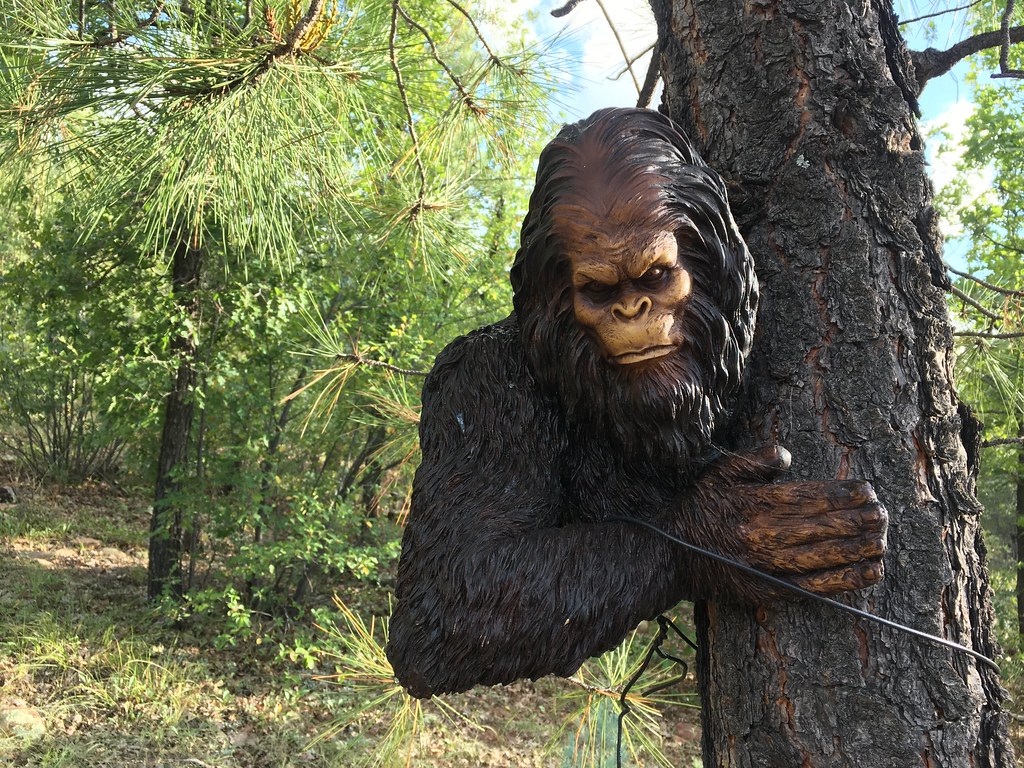
Sasquatch Encounter

A list of characteristics that are known to be present during Sasquatch encounters include:

 1) Bigfoot is said to be nocturnal 

 2) Bigfoot encounters are often times associated with a strong odor/foul stench. Usually described as rotting food/garbage mixed with wet dog. No one seems to be able to identify exactly what this odor might be, but it's very distinctive. 

3) Bigfoot is said to hunt small animals like squirrels, rabbits, and mice.

4)The elusive creatures have been known to knock over/rip up tents and sleeping bags on occasion. Probably searching for food.

5) Sasquatch has been known to produce a loud knocking sound.

6) Sasquatch is said to dematerialize. Blending into the surroundings at will. 

7) Bigfoot has been known to lurk in and around human campsites after the subjects have left. Studying the tracks or signs left behind by the intruders.

8) Sasquatch has been known to make loud noises, running around barking or growling before/during an encounter. In some cases, it's even said that sasquatch can be heard talking. 

9) Bigfoot is said to have large feet in proportion with its body size. 

10) Sightings of sasquatch are often accompanied by large amounts of hair.

11) Humanoid; covered with hair; bipedal; intelligent; sasquatch is said to be very fast and agile when fleeing or running away from a potential threat. 

12) Sasquatch is said to have an extremely powerful grip strength; capable of crushing, twisting, and snapping bones like twigs or branches in its hands.

13) Bigfoot's diet consists of mostly plants, fruit, and roots that it forages for on the ground and from trees in its environment.


In conclusion, if you happen to encounter a bigfoot, slowly back away and leave the area as quickly as possible. If you can't back away fast enough, try to get as far away from it as possible. Do whatever you can to keep yourself safe. Stay calm and don't panic. Once you're out of sight, try to find a place to hide until it's light out again. From there, you can follow tracks left behind and continue the search for answers. Better safe than sorry! 


Sunday, June 6, 2021

The Yeti

What is the Yeti? The Yeti (/ˈjɛti/),[1] also known as Meh-Teh in Himalayan folklore, is an ape-like beast purported to inhabit the Himalayan mountain range in Asia. In western popular culture, the creature is usually referred to as the Abominable Snowman. Supposed evidence of the Yeti's existence constitutes anecdotal visual sightings, disputed video recordings, photographs, casts of large footprints, etc. Some of these are speculated or known to be hoaxes.

Folklorists trace the origin of the Yeti to a combination of factors including Sherpa folklore and misidentified fauna such as bear or yak. Mainstream science has largely discredited the Yeti's existence for these reasons. Much like Bigfoot, a similar alleged creature said to reside in North America, the Yeti has become an icon of cryptozoology and a part of modern popular culture. To date, no evidence of the Yeti has been independently verified by scientists.

The scientific community has universally rejected the idea of a large, hairy, non-human creature located in the Himalayas. The World Conservation Union (IUCN) lists the Yeti in its "Green Book" as an "urban legend". The British Association for the Advancement of Science (BAAS) calls the Yeti "a non-existent animal". Cryptozoologists and other enthusiasts reject these statements, citing alleged sightings from all over the world and claims of Himalayan footprints as evidence.

Yeti

The origin of the Yeti claims appears to be in Nepal. The term "Yeti" is an amalgamation of the Nepalese words for "abominable snowman" (kuswa-ling) and is a reference to Sherpa folklore. The Sherpa people are a Tibetan ethnic group. The name "Sherpa" stems from Sherwa, meaning "east" in Tibetan. Sherpas are most closely related to the Kham Tibetans, but live in the Solukhumbu District of Nepal. They speak the Sherpa language, which belongs to the Tibetan branch of the Sino-Tibetan language family.

A Yeti is traditionally depicted as having a broad face and a rounded nose with wide-set eyes. The Yeti is substantially larger than most other indigenous bears found in Asia: it is usually described as being between 5 feet (1.5 m) and 10 feet (3.0 m) tall. The Yeti is also reportedly covered with dense fur, a trait that is characteristic of its presumed bear-like relatives in the genus Ursus.

In Indian mythology, the Yeti is a snow-demon. In Nepal, it is considered a spirit of ruggedness. The creature is rarely seen, and the locations associated with it are secret. Yeti sightings are also reported in Bhutan and Tibet (where it is known as the Migo). While some of these sightings and recordings have been debunked as hoaxes, casts of reputed "yeti footprints" from the Himalaya have been handed down from generation to generation as authentic artifacts. Well known sites that document footprints include Taklakot, Gokyo Ri, and Pangboche.

Cryptozoology is the study of hidden animals and was the creation of British zoologist Bernard Heuvelmans (1916-2001). Heuvelmans created the term cryptozoology in the early 1950s as a subdiscipline of zoology. The word, derived from Greek, means "hidden animals" (crypto-) and (-zoos).

Heuvelmans used cryptozoology to cover not only recently discovered animals but also any animal which has ever been suggested to exist but for which there is little or no evidence. This includes legendary creatures such as the Loch Ness Monster, Bigfoot, the Himalayan Yeti, and Yowie man, as well as extinct species such as the dinosaur. In its most extreme form, it may include even forms of life that have never been suggested to exist at all in modern times.


Bigfoot Skeptics

Bigfoot skeptics are people who believe that Bigfoot does not exist. They argue that there is a lack of evidence to prove the existence of Bigfoot. Skeptics also say that there are many hoaxes of Bigfoot being caught on camera. Skeptics claim that sightings of Bigfoot are misidentifications of other animals, such as black bears. They also argue that Bigfoot is a combination of several smaller animals combined to make one big animal.

Bigfoot skeptics say that the lack of fossil evidence is proof that Bigfoot never existed. They believe that most people who believe they have seen Bigfoot are confused and are seeing things. Skeptics also say that most people who claim to have seen Bigfoot are just looking for attention. Cynics also say that people who claim to have encounters with Bigfoot are just looking for a good story, or they are using Bigfoot to get their names in the news. Doubters say that there has never been an actual picture or video of a real Bigfoot.

Bigfoot skeptics say that people who claim to have captured Bigfoot are lying. They say that people who claim to have captured Bigfoot on camera are easily fooled by things like bears, and sometimes they pretend to be Bigfoot in order to get money or attention. Cynics also say that some creature calling itself Sasquatch is a man in an ape mask, not the real thing at all. Some doubters study photos and videos of supposed Sasquatch and find that the video footage was shot at the same time as some other animal. Critics also say that hoaxers use wires attached to their clothes so they can manipulate their images on a camera. Skeptics say that this is the most common hoax used by those who claim to have captured Bigfoot. 


People who are skeptical say that if there was a real Bigfoot kept in captivity, it would be easy to prove. Skeptics think that if the government had a real Bigfoot in captivity, they would bring him out. Skeptics believe that the people who tell stories of having encounters with Bigfoot are mostly men making up stories or women with mental problems believing what they see, or children making up a story or just getting into mischief and finding it interesting and fun to lie about stuff like this. Bigfoot skeptics do not believe that Bigfoot exists. They say that such creatures do not exist and there is no concrete evidence that they exist. Some skeptics believe that Bigfoot does exist, but it is just a legend or a myth. These skeptics do not believe Bigfoot exists, but they do agree that the legend is interesting.

A common idea in the skepticism community is that reports of Sasquatch sightings and encounters are the result of primates concealed in bushes or trees. Proponents of this theory describe a primate such as a spider monkey, chimpanzee, or gibbon (the last two being common in North America) being seen from an angle that conceals its hands and feet, thus giving the impression of a "man-ape" type creature. 

According to proponents of this theory, many witnesses have spotted these primates without realizing what they are seeing, and so turn Bigfoot into a "monster". There are numerous clips on YouTube which supposedly show spider monkeys (for example) perched in trees. Some skeptics dismiss these clips as inconclusive. A British researcher who has spent over 30 years investigating Bigfoot claims calls himself a skeptic when it comes to the subject but does not believe it is fake. He thinks that the lack of bones and carcasses found over the years is due to the fact that Sasquatch either decomposes very quickly or its remains are eaten by other animals such as bears or wolves.